Cave Paintings

Picasso once stated, "They’ve invented everything," referring to early human civilizations who created cave paintings. Cave paintings are a unique and intricate art form, using readily available minerals in red, yellow, black, brown, and violet. The early artists likely made broad black outlines with mats of moss and hair. Illustrations were also made by blowing paint directly from the mouth or through tubes made from hollowed bones, some of which have been found in caves. This marked the early stages of visual communication within the realm of graphic communication. These illustrations, composed of symbols, depictions, and drawings, allowed early humans to create awareness and convey meaning.

Hands at the Cuevas de las Manos upon Río Pinturas, near the town of Perito Moreno in Santa Cruz Province, Argentina. Photograph by Wikimedia Commons. Retrieved from Wikimedia Commons. Licensed under CC BY-SA 3.0.

Great Black Bull & Large Black Stag at Cave of Lascaux, Southwestern France. Photograph by © N. Aujoulat (2003) © MCC-CNP retrieved from bradshawfoundation.com/lascaux
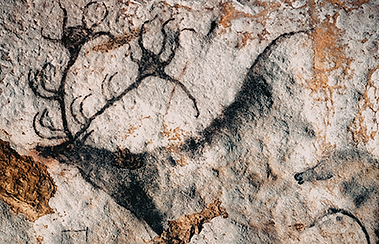
Many believe that the artworks depicting animals represented a victory after a hunt, a ritual before the hunt, or a form of instruction for others. Others think the drawings served to warn later visitors of the cave about dangerous animals, as many creatures were depicted with exaggerated teeth and horns, possibly communicating a need for safety. This demonstrates the early stages of visual communication, the cave paintings were a tool for communication, a message left behind for others to interpret, including researchers in the present day.